Godzilla (Game Boy)


Godzilla. A lizard so colossal he can crush buildings beneath his feet. With his atomic breath, he can raze a city block. To let the player experience Godzilla’s legendary might in a video game could be quite a thrill, and looking at the cover of Godzilla for the Game Boy, you might think that’s what you’re in for. However, in this Godzilla game, it’s not about giant monster battles in cities. Instead, Godzilla will be climbing vines, punching boulders, and needing to make sure he doesn’t fall onto spikes as they’ll lead to an instant death.
The adorable and small version of Godzilla seen in-game might feel like an outright betrayal to some, but it does have precedent. Japanese fans of the king of the monsters are more likely to be familiar with the Godzilland brand, a merchandise branch of the monster movie franchise that depicts the usually fearsome creatures as small and friendly cartoons. Godzilla on Game Boy is a port of a puzzle game released on MSX computers in Japan, going by the less deceptive name of Godzilla-kun. That release’s box art is much more honest about how the kaiju in-game will appear, something that doesn’t hold true in the American release or the even more intimidating looks chosen for European releases. This Game Boy game may at least be able to say depicting the giant monsters in their usual form on the box isn’t entirely a trick though, mostly because from time to time a little scene with a tip between levels will be accompanied by a still image of one of the movie monsters looking like their regular fearsome selves.
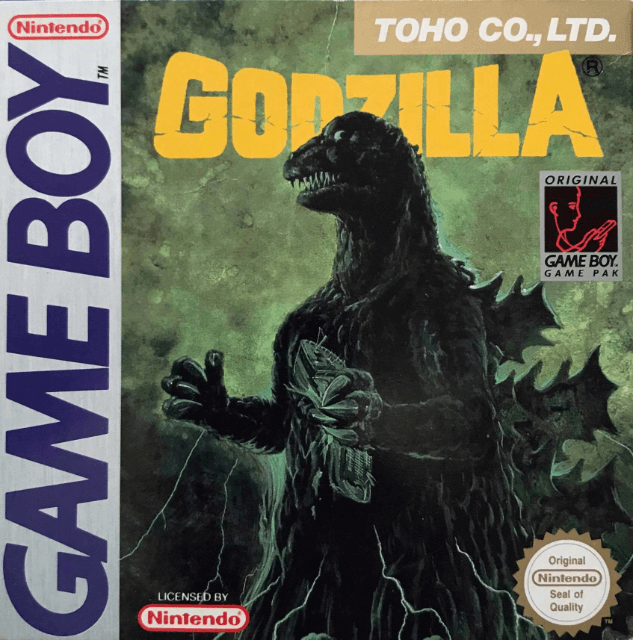
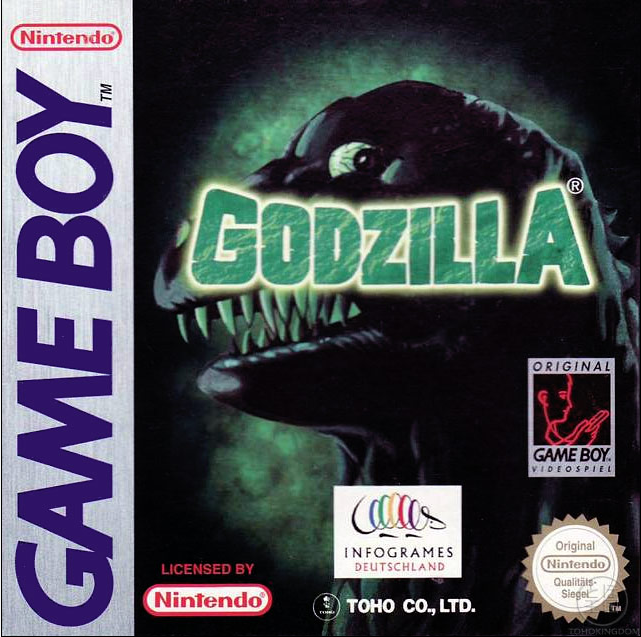

Once you’ve gotten used to the idea this is not going to be a giant monster battler, you can begin to approach Godzilla for Game Boy for what it does offer. Godzilla’s son Minilla has been captured by the other monsters and placed deep within a 64 room labyrinth know as The Matrix. To progress through this maze, Godzilla must destroy every rock in a room to reveal the arrows that serve as exits. Right at the start though, we face a few issues born from this premise. The Matrix is a large 8×8 square grid of smaller rooms and you aren’t asked to head to every single one. However, while Minilla is found in the same room every playthrough, you won’t know where he is to start, so you need to go through room by room trying to reach him. This can be fine at first, but some factors make this more tedious than it should be. The maze will have dead ends or circuitous routes, and while seeing new levels can be interesting, what isn’t so fun is replaying a puzzle in a puzzle game. When you already know a solution and all that is left is the execution, doing it again just to take a different path is tedious and a poor reward for trying to explore more of the Matrix. What might sting even more though is how the exits appear. When you’ve destroyed the last rock, the arrows leading to other rooms appear immediately. These can appear right where Godzilla is standing or essentially trap him since he lacks a jump, meaning it is quite possible to end up down a road you may not want to be on.
The rock pushing and breaking puzzles can be made unwinnable if you do them improperly, a rock only breaking if it can no longer be shoved further with your giant fist thanks to an obstruction like a wall or another rock. Thankfully, the game does offer a way to reset levels in the game’s Select menu, although it costs a life to do so. This can help you if you’re trapped by an unfortunate arrow as well, and in a rather nice touch, every level you beat grants you a life so it’s not too rough to have to use the reset feature. Even more helpful though is the fact you can pause as soon as a level starts and look around the area freely. No enemies will move as you do so and they are never part of a room’s block pushing puzzle either, meaning you can just leave it paused as long as it takes to figure out the sequence of actions needed for success. In a rather odd touch though, Godzilla’s boulder pushing punch frequently relies on you to stand at the very edge of a platform to hit your targets. Usually his reach is only the immediate space in front of him, but if you’re technically half inside a space, that means half of your punch can reach over a gap that the kaiju normally can’t cross due to his lack of a jump. It’s sometimes easy to fall while trying to line these gap-crossing punches up though, and due to the small levels often requiring actions be done in a certain order or you might not be able to reach things, this can lead to a stage restart. The password system at least makes starting at any level a possibility if your lives do run out, the game even offering a smaller and simpler one if you only care about the room you’re in while an 18 character one will also include the map that shows you which rooms in the Matrix you’ve already been to and how their exits line up.

Most of the time in Godzilla for Game Boy, the puzzle platforming is going to heavily involve properly pushing stones around to break them, and later levels can start to ask you for more advanced tricks like making temporary towers and bridges before you break the boulders they’re built from. When the game is laying out a logic puzzle on trying to figure out the sequence of actions, it can cook up a few strong designs, although it has some very strong duds as well. One level for instance will have a rock dropping immediately towards you to crush you, and if you try to run off before it does, the level is unwinnable. What you need to do is immediately punch the rock in front of you before it’s blocked off by the falling one and then scurry to the left. There is no more to the level’s puzzle beyond solving this killer trap, it almost feeling like a deliberate attempt to waste some lives since there is little else going on in the level.
At other times though, the levels in Godzilla for Game Boy feel weak because they’re not trying to build enough of a puzzle, instead relying on the threat the other monsters pose. In a good deal of the game’s stages, entrance doors will allow monsters to repeatedly enter the battle, and while you can kill most with a single punch, they’ll reappear from those doors eventually to harass you once again. Mechagodzilla, Baragon, and Anguillas (who is an incorrectly named Anguirus) are barely worth worrying about, all of them just trying to run up and ram into Godzilla. You have a good amount of health too, making these basic threats only require the occasional punch to keep them out of your hair, but the other two major kaiju are a bit peskier. The trash monster Hedorah, going by Hedrah here, is impervious to most damage. You can crush him with a boulder, but your punches just push him back. Your generous health means if he’s in your path you can just walk through him and accept the damage, and all health is restored when you head to the next level to mitigate these sometimes necessary sacrifices. Rodan the pterosaur kaiju is more annoying though, mostly because he can fly around levels ignoring all solid barriers in his efforts to reach you. Sometimes you have to stop your work just to wait and be ready to hit him so he won’t hound you during your work. Occasionally power-ups can make clearing them a bit easier, like an hourglass to stop them entirely for a bit or the lightning bolt to instantly wipe them out, but again, these characters are mostly nuisances rather than contributing much to the level design or challenge.
Most levels that lean on the threat these monsters pose aren’t that engaging, the game even mostly doing away with them the closer you get to Minilla, but there is one more foe in the form of Ghidrah, the game’s mistranslated name for the three-headed dragon King Ghidorah. Ghidrah is completely invincible and fairly fast, the hydra meant to punish a player who has lingered too long in a level with an unkillable foe. This feels like a bit of an odd touch considering the pause button already lets you consider every level at your leisure and the puzzle solving that is so focused on moving things to exactly where they need to be feels at odds with something trying to enforce speedy play. Perhaps there was a fear that the endgame’s more complicated puzzles being entirely monster free would be straying too far from what Godzilla is known for, but because of how this game is designed, it’s a game about kaiju where you want to see them less since they’re almost all bothersome rather than compelling or awe-inspiring dangers.

THE VERDICT: Godzilla for Game Boy could have just been a fairly decent block pushing puzzler, some of its rooms offering good mind-bending tests of your ability to plan ahead. Once you get used to the idea of a city-crushing titan now small, cute, and climbing vines in tiny rooms, his history unfortunately jams its head in with other kaiju who are pests rather than interesting threats. Your work solving puzzles is much more interesting than keeping the boring monsters at bay, but then the Matrix’s maze-like arrangement makes progressing unnecessarily complicated, retrying levels because you went down a pointless path not really enjoyable before you even factor in the potential for accidentally standing on an exit as it appears.
And so, I give Godzilla for Game Boy…

A BAD rating. Godzilla for Game Boy could have almost worked as a straightforward set of 64 puzzle levels, and maybe a version of the game where you weren’t Godzilla at all could have been a decent little adventure since some stages are arranged well to make you think while giving you the lives needed for some experimentation. Godzilla brought some baggage with him to this adaptation though. The monsters were added to the game in such a boring manner, often posing little danger so long as you routinely manage them or becoming outright annoying when Hedrah’s blocking a vital route or Rodan keeps making you come to a stop. The game almost dropping them entirely later on feels telling, like it had few ideas for how to integrate them in interesting ways. There could have been potential for them to contribute more directly to the puzzle solving, like Hedrah being a barrier you have to properly deal with rather than just accept the damage and move along, but instead most levels that features the other kaiju heavily often provide weaker puzzles as a result. The game could have worked either entirely without them or by integrating them in interesting ways, but instead it throws them together sloppily in a large maze that benefits little from the need to travel through it in such a manner. There would be enough quality levels among the 64 on offer for a good path for the game to exist, but instead it’s likely between the well-designed ones you’ll get cheap ones like that boulder trap that make looking for other levels a less exciting prospect.
Godzilla for Game Boy isn’t bad because it’s a somewhat inexplicable puzzle platformer, it’s bad because it didn’t follow-through on that strongly enough. What could have been a quirky adventure for the usually fearsome king of the monsters instead feels tedious and too cluttered with levels that don’t explore its puzzle formula the best. There may be some mix of passwords that let you see what the game could have been had it not felt beholden to include other kaiju, even just the final few levels on the right path to Minilla already a pretty good bunch for seeing the boulder pushing does have room for some interesting challenges. Instead, the Matrix all but ensures you’ll get tired of its type of play, few left walking away happy from this strange video game adventure for the movie monster.